Exploring and driving the adoption potential of personal data stores
An exploratory design study, spanning quantitative & qualitative research and iterative low-to-high-fi prototyping to validate and optimise the adoption potential of personal data stores.




The challenge
Personal data stores (PDS) are a promising technology for users to bundle their personal data into a single, secure location under their own control, enabling innovative cross-platform data usage. Despite these benefits, corporate adoption of PDS technology has remained limited.
To support the Open Data Institute (ODI) in accelerating PDS adoption, this project investigated the primary drivers and barriers influencing user acceptance. We explored end-user attitudes and translated those insights into high-fidelity interactive prototypes for usability testing and client engagement.
- My role
- UX designer
- Partners
- Open Data Institute (client)
- Status
- Completed
The process
01 — Scoping
Defining the use cases
To identify the most viable domains for implementing personal data stores, we defined four high-potential use cases based on industry interest. Partnering with leading organisations, including recruitment agency Randstad and public broadcaster VRT, we scoped the following applications:
 HR
Seamlessly matching candidates with career opportunities by integrating verified diplomas, location preferences, and professional interests directly from their PDS.
HR
Seamlessly matching candidates with career opportunities by integrating verified diplomas, location preferences, and professional interests directly from their PDS.
 Media
Delivering personalised streaming recommendations by securely leveraging cross-platform data, such as Spotify listening habits and viewing histories.
Media
Delivering personalised streaming recommendations by securely leveraging cross-platform data, such as Spotify listening habits and viewing histories.
 Finance
Aggregating multi-bank and investment data into a unified, secure financial dashboard owned and controlled entirely by the user.
Finance
Aggregating multi-bank and investment data into a unified, secure financial dashboard owned and controlled entirely by the user.
 Health
Enabling secure sharing of wearable metrics and activity data with healthcare professionals to facilitate proactive, personalised care.
HR · Randstad
Diplomas
Work experience
Personality test
Contact details
Media · VRT
Viewing history
Listening history
Social media usage
Finance
Transaction history
Salary
Subscriptions
Health
Medical history
Medication
Activity
Health
Enabling secure sharing of wearable metrics and activity data with healthcare professionals to facilitate proactive, personalised care.
HR · Randstad
Diplomas
Work experience
Personality test
Contact details
Media · VRT
Viewing history
Listening history
Social media usage
Finance
Transaction history
Salary
Subscriptions
Health
Medical history
Medication
Activity
02 — Market research
A large-scale survey with 2,335 respondents
To gain initial insights into the adoption potential of these use cases and to learn more about users' willingness to share data in these contexts, we started out with a large-scale survey with 2,335 respondents, in which participants evaluated the four personal data store use cases based on written scenario descriptions.
The survey revealed that the Health use case had the highest adoption potential among respondents. In contrast, the likelihood of adopting personal data stores decreased significantly with age across all domains, as illustrated below.
Willingness to share data differed strongly across domains. Remarkably, Health data was shared most readily (over 80% for medical history and medication), followed by HR data such as diplomas and work experience (around 70%). Media and especially Finance data were met with more hesitation, particularly for sensitive details like transactions or social media activity. Overall, users were more willing to share data when its relevance and benefit were clear.
03 — Initial prototyping
Designing user flows
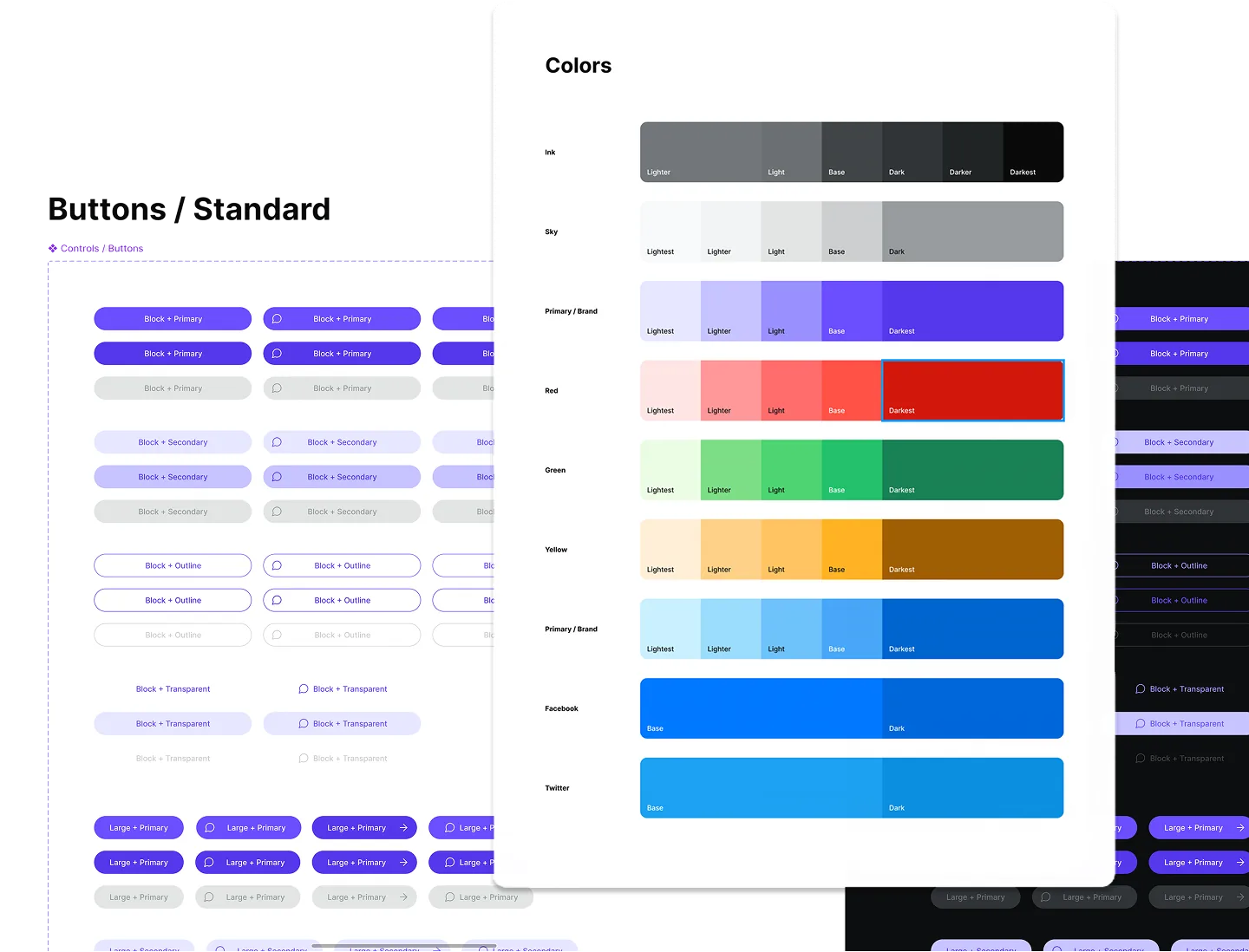
To quickly design a first tangible prototype of the personal data store and the use case scenarios, a design system was leveraged to rapidly prepare an initial version ready for expert review.
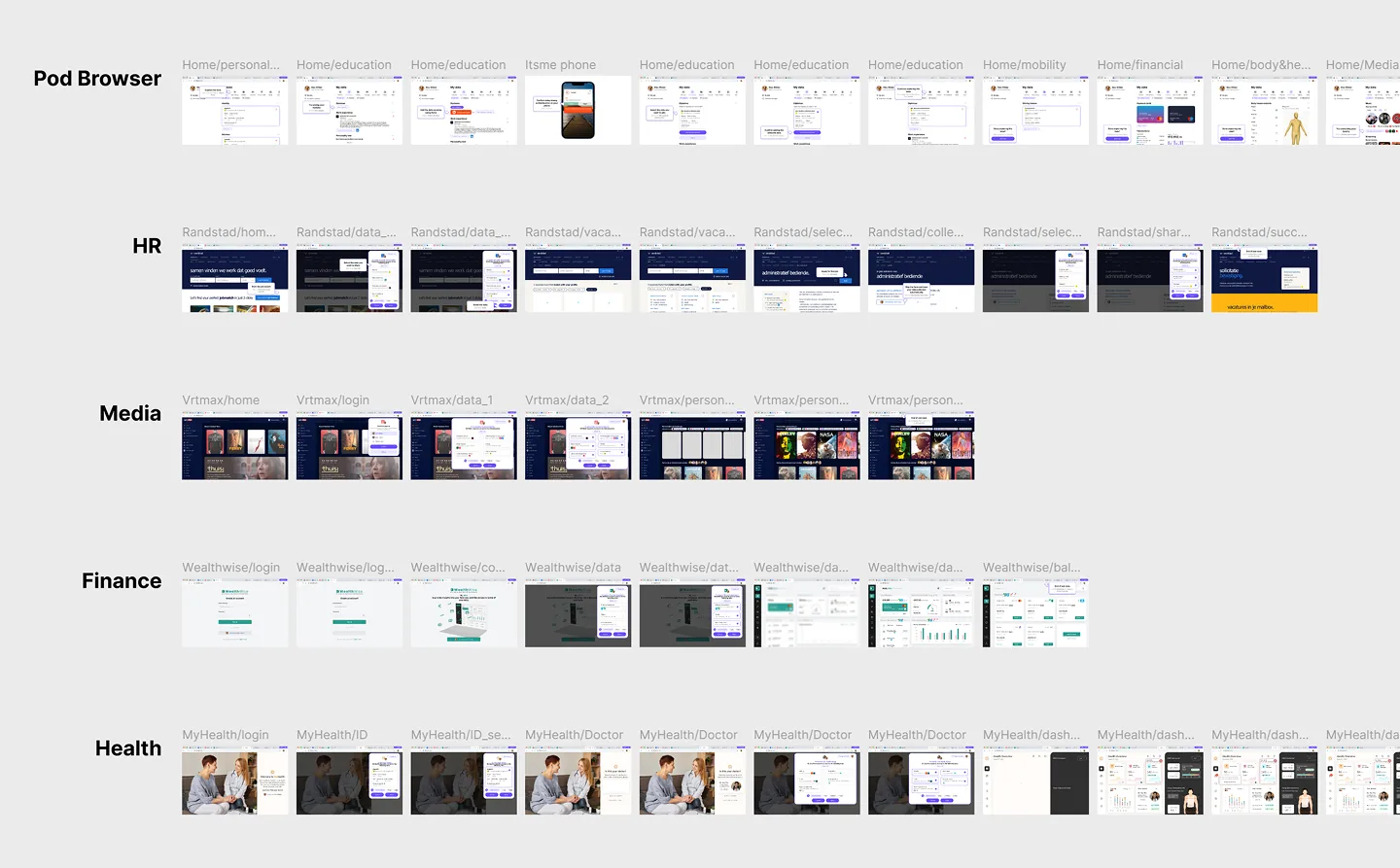
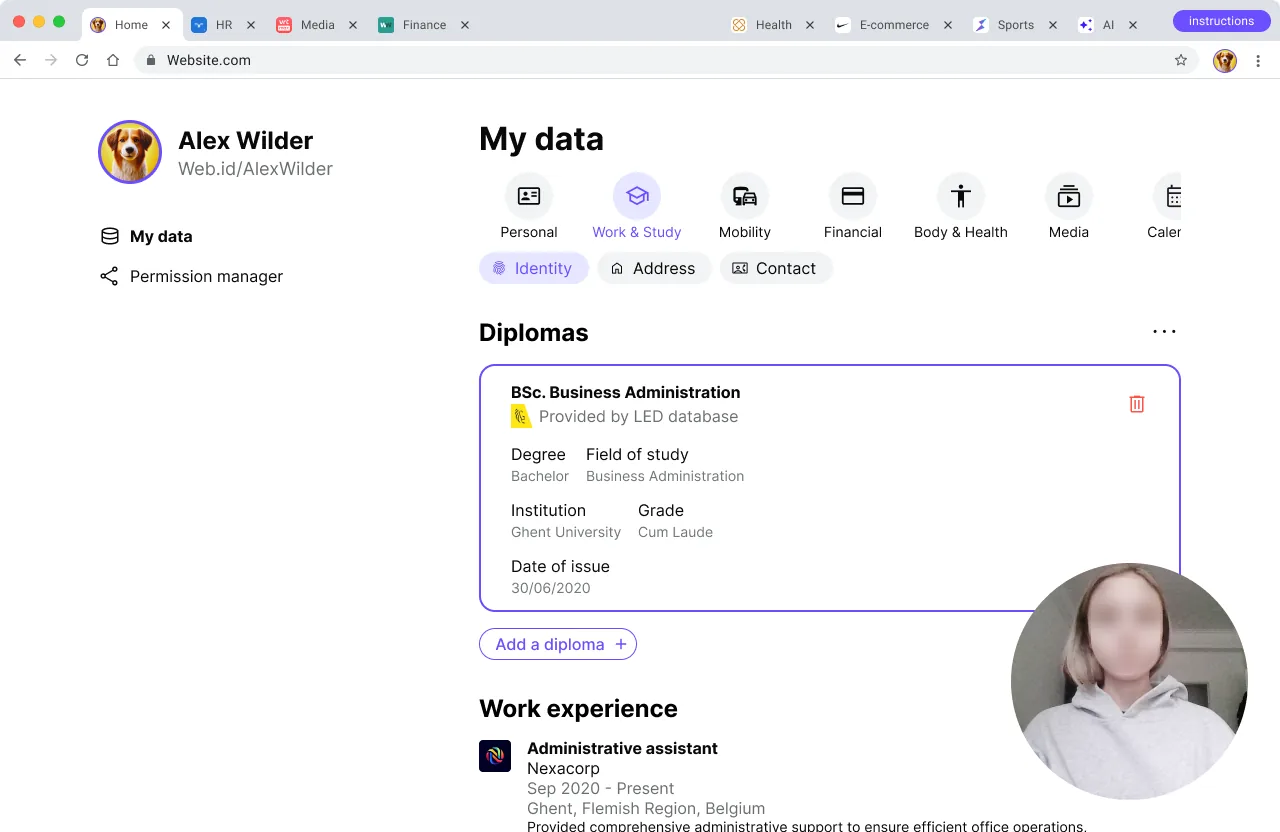
The resulting prototype featured the central personal data store, structured as a dashboard visualising the full range of storable user data. In addition, user flows were designed for the four use cases to demonstrate how external services can leverage the data in the PDS to enhance their services, while the user stays in control of who accesses which data.
04 — Expert review
Gathering feedback from industry specialists
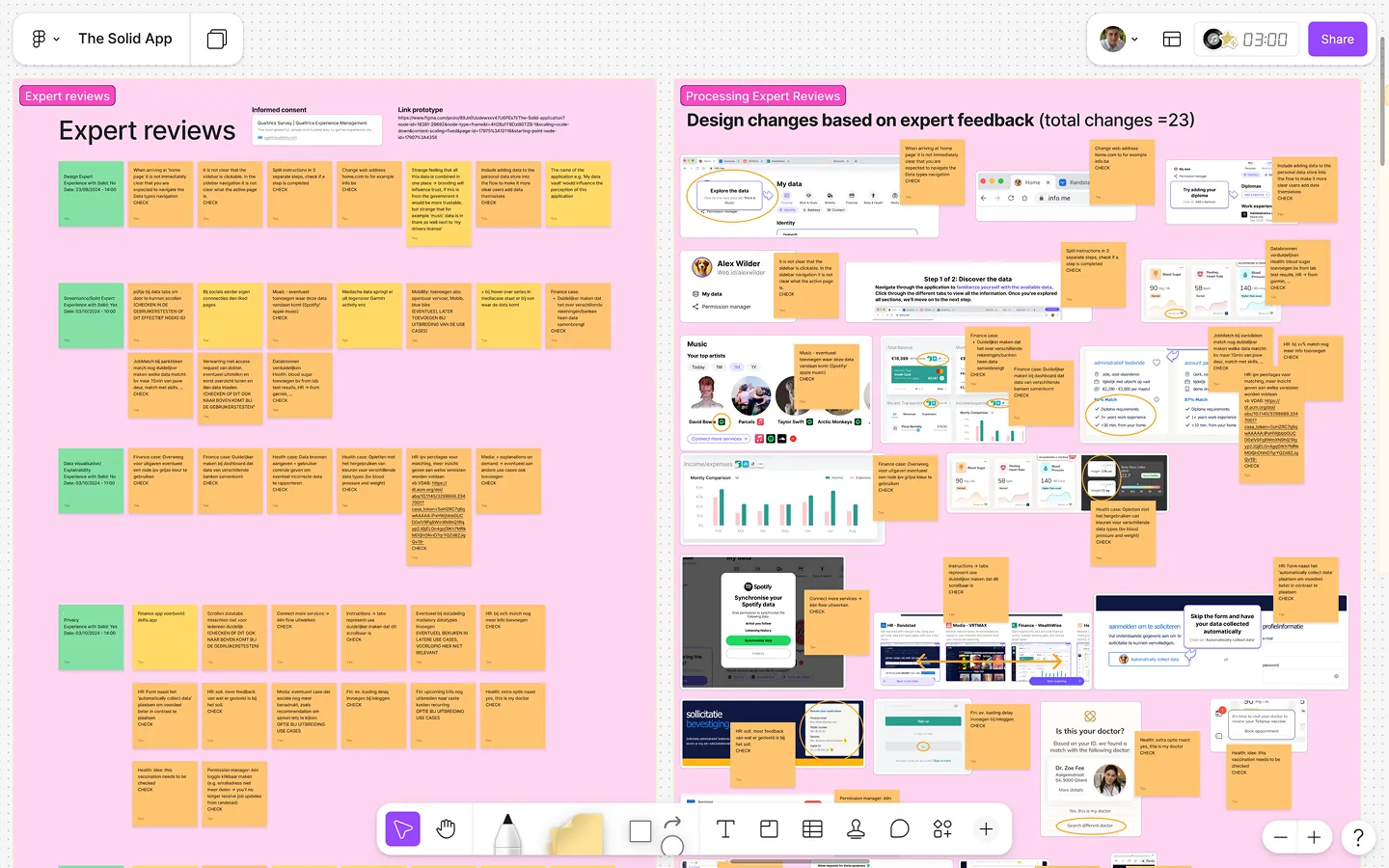
Before user testing, the prototype was refined through a series of expert reviews with ten professionals from fields including UX design, product development, and privacy. Each expert navigated the prototype using a guided walkthrough. Their observations were organised in an affinity diagram, which helped identify recurring themes and actionable insights.
05 — High-fidelity prototyping
Creating interactive prototypes
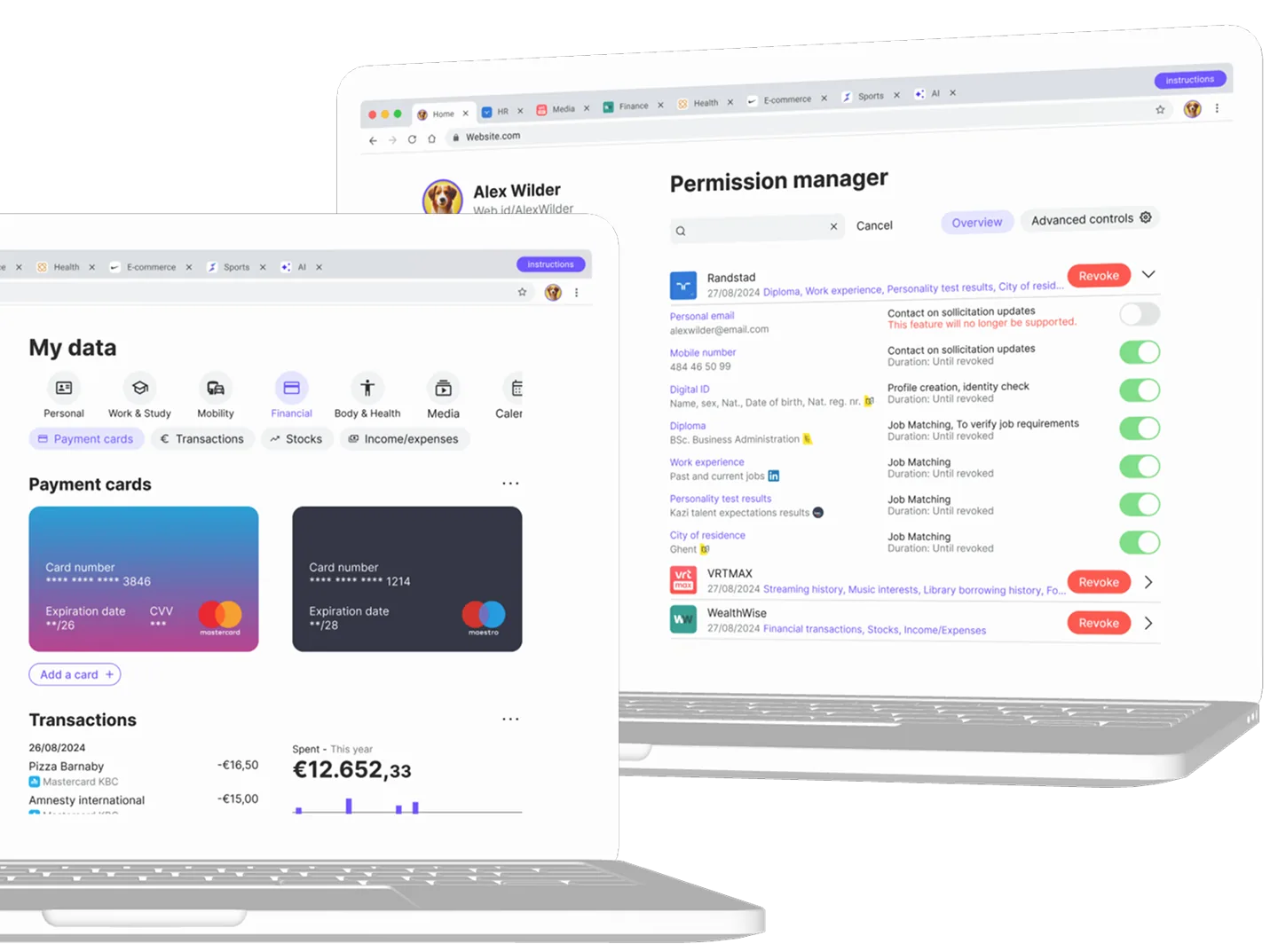
These findings from the expert reviews directly informed the second high-fidelity iteration of the interactive prototype, which was then used for user testing.
Personal data store
06 — User testing
17 think-aloud sessions
To evaluate the PDS concept and the use cases, 17 participants took part in one-hour online sessions. Each session followed a structured flow combining think-aloud walkthroughs, a semi-structured interview, and a short post-test survey.
07 — Results
Qualitative insights
“Interesting to have that in one location instead of having 456 different apps for it.”
Participant
“If they have the one password from that platform, they can get to all your data, but really everything. To your medical records, to your banking details, to your music preferences. Where you live, what newspaper you read. Yeah, you do not want that.”
Participant